The city is turning to neighborhood emergency teams to fill in the gaps in the region's heat wave response. by Isabella Garcia
During the unprecedented deadly heat wave in June 2021, overheating Portlanders languished in the stifling temperatures for up to 90 minutes as they waited for a taxi or an Uber to take them to an emergency cooling shelter.
This year, during the record-breaking weeklong heat wave in late July, over 200 people requesting a ride to a cooling shelter were picked up in 15 minutes or less.
“If someone is deciding that it’s better to go to a shelter than to be where they are, they are in crisis,” Portland Bureau of Emergency Management (PBEM) coordinator Tigger Subotnick said. “We don’t want anyone waiting out in the elements a nanosecond longer than necessary.”
The dramatic decrease in response time can be attributed to PBEM’s new Ground Support Guest Transportation Unit—a program that offers a city-run alternative to relying on rideshare and cabs to transport people to cooling shelters. The program leans heavily on Portland’s Neighborhood Emergency Teams (NET)—volunteer-run neighborhood groups that the city relies on during emergencies.
NETs were established in 1994 with the intention of training neighborhood volunteers to respond to the Cascadia Subduction Zone earthquake—the predicted 9.3 magnitude quake that will eventually devastate the West Coast. Members of the 57 Portland NETs serving over 80 neighborhoods receive 28 hours of training from PBEM, which oversees the program, on how to be self-sufficient for up to two weeks and help others in an emergency.
“We don’t want anyone waiting out in the elements a nanosecond longer than necessary." — Tigger Subotnick, PBEM coordinator
However, as climate change has created more frequent and severe weather events like heat waves and ice storms, the focus of the NETs has shifted from preparing for an eventual earthquake to building a safety net to support neighbors during climate emergencies.
“We’re finding that with the deadly heat events, [the NETs] can have more impact moving towards community resilience and neighborhood cohesiveness,” said NET program manager Jeremy Van Keuren.
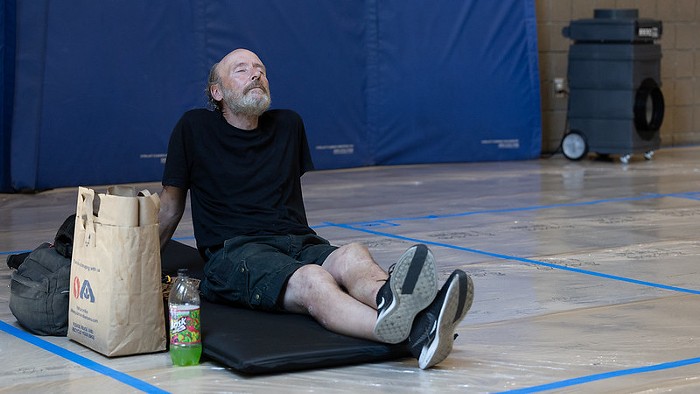
PBEM started reevaluating the role the NETs can play during extreme weather events after 2021’s heat wave that killed 69 people in Multnomah County and nearly 100 statewide. Cooling shelters—air conditioned community centers and gymnasiums stocked with sleeping pads and snacks—became a critical element of the city’s response to the heat, but actually getting to a cooling shelter proved difficult for Portlanders. Anyone who needed a ride to a shelter was instructed to call 211—the county hotline used during emergencies—which would coordinate a taxi, Lyft, or Uber ride for them using existing contracts the county had with various transportation and rideshare companies. However, due to the ongoing pandemic and unprecedented heat, drivers were in short supply and wait times for a ride lasted well over an hour during the hottest parts of the day,
A guest at the East Portland Community Center cooling shelter. Motoya Nakamura/Multnomah County
To cut down on the transportation response time, Subotnick turned to the NETs—2,024 volunteers across the city who are trained and ready to respond to a crisis at a moment's notice. While NET volunteers were already activated during heat waves to oversee misting stations and help run cooling shelters, Subotnick wanted to leverage the group of volunteers to fill in the gaps of Portland’s heat response system and started developing the ground support program in late August.
The ground support unit is activated when someone calls 211 requesting a ride to a cooling shelter. The 211 employee gathers information about the caller's needs and where they are and passes the information to a ground support dispatcher, usually a NET volunteer, who then assigns a transport vehicle staffed by a driver and a navigator to the call. In addition to NET volunteers, city and county employees can also help run the program while earning overtime.
During the program’s first run during a December 2021 cold snap, there were 74 drivers operating two vehicles for six days, averaging a 38-minute response time in the snow. During last week’s heat wave, the program had 112 drivers using a fleet of six city-owned vans for seven days straight and averaging 10 to 15 minutes from call to pick up.
Throughout the record-breaking emergency heat declaration, 211 received 215 ride requests, 138 of which were completed by NET volunteers while the rest were covered by rideshare drivers or cabs. Volunteers also gave 47 rides to people they encountered on the street, in the process of leaving a cooling shelter, or other situations that weren’t coordinated through 211.
“It takes a small army of people to make this work,” Subotnick said.
That army includes Janel Hovde, an associate pastor at St. Johns Church and member of the St. Johns NET for the past year. Hovde spent the week working a minimum of three, three-hour shifts per day dispatching rides, coordinating drivers on the ground, and training new program volunteers,
“It fuels me,” Hovde said of the work. “When my passion goes up, I'm the Energizer Bunny.”
“It takes a small army of people to make this work.” — Tigger Subotnick, PBEM coordinator
Hovde’s passion for helping her community stems from her experience thirty years ago, when she desperately needed support but couldn’t find any community programs to connect with.
"I was a single mom in a really bad domestic violence situation and there was no help,” Hovde said. "That's part of why my heart is so strong about being able to help others, because there are services available and resources that can help people.”
Having her heart in the work is motivating, but can also be heartbreaking. As a dispatcher, Hovde doesn’t interact with callers needing a ride directly, but rather sees their descriptions in the queue as she delegates the rides to various drivers. Seeing person after person and sometimes entire families who need transportation line up in the queue during high-demand hours can be taxing, Hovde said, simply from seeing how much need for safe, cool spaces there is in comparison to the increasingly common heat waves.
The people who are actually interacting with riders are drivers like Allan Cordova, a psychologist and member of the Sellwood NET for the past seven years. On Friday, Cordova volunteered for a four-hour afternoon shift, driving a 15-passenger van back and forth from the East Portland Community Center to the Portland Building, which had been converted into a temporary cooling center, downtown.
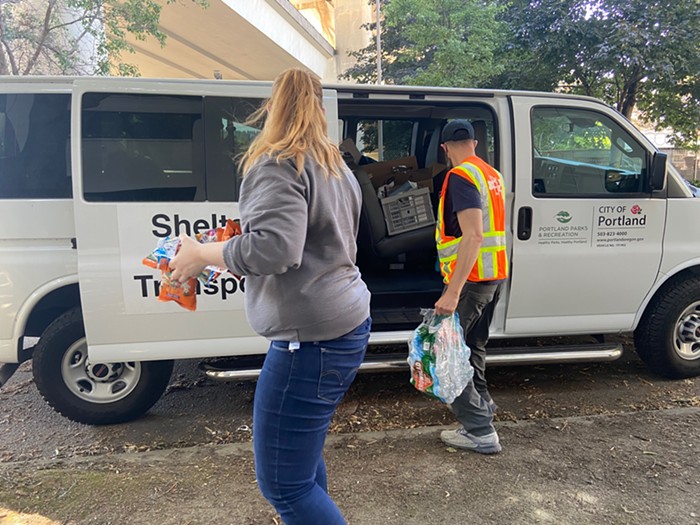
City volunteer Sandra (left) and Allan Cordova preparing to distribute water and snacks to people outside. Isabella Garcia
Whenever drivers aren’t actively responding to a call, they are encouraged to pass out water and offer rides to people outside, particularly homeless Portlanders who may not have access to a phone to request a ride through 211. Cordova and a city volunteer handed out water bottles and snacks in Old Town—which were readily accepted as temperatures climbed toward 100 degrees for the fifth day in a row—but no one was interested in a ride to a cooling shelter.
PBEM leaders are considering how the NETs can be further leveraged to respond to unique outreach problems revealed by the previous heat waves.
The majority of Multnomah County residents who died during the 2021 heat wave were renters living alone in apartment complexes without an AC unit. Following their deaths, emergency response officials noted how difficult it is to identify who needs help during a heat wave because, unlike other natural disasters like floods and fires, there are no clear indicators of which residents have access to AC and who is suffering in a hot apartment.
Lyle Crawford, 62, was one of the people who died in their home during the June 2021 heat wave. Crawford only had access to a box fan and didn’t have a smartphone to receive the emergency texts sent by the county urging people to go to cooling shelters.
“He would have answered the door if someone knocked, and that might have done it,” said his sister Donna Crawford in a county report. “An actual human being. But how can there be enough human beings to go to the door of every older person?”
NETs could offer a solution to that problem. Hovde believes that because NET volunteers are already part of their neighborhood, they are in a prime position to know their neighbors’ needs and launch the door-to-door outreach necessary to help people during a heat event. Laying a proper foundation for that type of outreach and community connection is a critical step in the approach.
“You have to gain the trust to be able to talk to people [in the community] and be open and honest and be able to listen to if they have needs—not just tell them what they need,” Hovde said. “Know your neighbors, but don’t just hand them fliers.”
“Know your neighbors, but don’t just hand them fliers.” — Janel Hovde, NET volunteer
With more than 2,000 volunteer applications waiting for PBEM’s review to join their local NET, scaling up the program to act as a heat wave taskforce is feasible. NET manager Van Keuren is already considering adding additional training to the NET program that could help facilitate the shift towards community resilience and outreach during weather events.
For the Portlanders currently looking to join their local NET, Hovde said the only requirement—in addition to the training—is to have a heart.
“This is about giving yourself, because this is volunteer,” Hovde said. “This is your time. This is your energy. You have to want to—it’s a true desire.”
A woman wants to share her husband with other women... so what does one call that? Dan Savage issues a ruling in this week's SAVAGE LOVE! by Dan Savage
This is a preview of this week’s Savage Love. The full version is now exclusively available on Dan’s website Savage.Love.
I’m a 36-year-old married woman who fantasizes about her husband of 10 years being intimate with other women. This isn’t a new thing for me. I’ve fantasized about this for years, but we’ve never acted on it. He is intrigued but afraid that it might somehow damage our relationship. But I’ve done some research on it and it’s something I’m eager to try. (With my husband’s consent, of course!) But in all my research, I’ve found different and sometimes conflicting definitions of what it means to be a “cuckquean.” I’m interested in watching my husband pleasure and be pleasured by another woman in a purely physical way. I’m not interested in being “cheated on.” No flirty texts, no unsanctioned coffee dates. I’ve read accounts of women who are turned on by the humiliation and insecurity of their partner being with others, often women the husband knows “in real life,” either through work or through social life. In my case, I would rather my husband not even know the name of the other woman. And he would only be able to sleep with her with my consent and I would want to be “in control” of the situation. So, what does that make me? Do cuckqueans come in all different proclivities? I feel like the end result is the same—my partner bedding someone else—but my motivation is different than what I’ve seen.
What The Cuck Am I?
“The scenario WTCAI describes sounds more like hotwifing with the gender roles reversed than cuckolding,” said Venus, host of The Venus Cuckoldress Podcast. “She’s interested in hothusbanding!”
Let’s quickly define terms: a man into hotwifing enjoys “sharing” his wife with other men, WTCAI, and a woman into hot husbanding enjoys “sharing” her husband with other women. (All this sharing, of course, is consensual.) Cuckolds, on the other hand, aren’t sharing their wives. They’re being “cheated on” by their wives. And cuckqueans aren’t sharing their husbands. They’re being “cheated on” by their husbands. Cuckolds and cuckqueans, by definition, don’t just wanna see their spouses fucking another person, they also want their partners to humiliate and degrade them. (I put “cheated on” in quotes because the “cheating” is consensual and symbolic; likewise, “sharing” is in quotes above because spouses aren’t property.)
“But cuckolding and hotwifing have a really wide spectrum of practices and dynamics,” said Venus. “Some cucks are submissive and get into degradation and some cucks really aren’t subs or into degradation at all. I don’t see why hothusbanding/cuckqueaning can’t be just as varied. Humiliation, submission, and degradation don’t have to be involved!”
Venus is right: there are guys out there who call themselves cuckolds but aren’t subs and don’t wanna be humiliated or degraded. But I would argue that these guys aren’t cuckolds, WTCAI, just as I would argue that you aren’t a cuckquean. We have lots of words to describe letting your partner fuck other people—open, monogamish, swinging, mate-swapping, hotwifing, hothusbanding, stag and vixen, CNM—but we only have one word to describe letting your partner fuck other people while getting off on being humiliated and degraded: cuckolding. And since most people understand cuckolding to involve humiliation and degradation, telling someone you’re a cuckold when you’re not into those things is like telling someone you’re a power bottom when you don’t like anal or telling someone you’re into impact play when you don’t like having your ass so much as tapped. It confuses rather than clarifies. What’s worse, tell someone you’re a cuckold/cuckquean and they might start degrading you while they’re fucking your partner, which would ruin everything for everybody.
As for setting up a sex date for your husband with an anonymous woman, Venus had a practical suggestion.
“There are a lot more men out there looking for casual sex than there are women,” said Venus, “which makes WTCAI’s fantasy difficult to pull off. But I know a woman whose wife wanted to be blindfolded and then have a group of women come in—all strangers to her—and go down on her. Not an easy fantasy to pull off either! So, they hired a sex worker to facilitate things and it was amazing. Perhaps this would be an ideal solution—hiring a sex worker—because then WTCAI would be in total control.”
Finally, WTCAI, re-reading your letter just now… it sounds to me like what you really wanna do is… whore your husband out. It’s an expression I’ve heard gay men use to describe setting up an anonymous encounter for their boyfriends or husbands. You find someone you wanna see fuck your husband—taking care to find someone your husband would wanna get fucked by—and all your husband needs to know is when and where. Cuckolds and cuckqueans are subs and a sub can “top from below,” as the saying goes, but at least officially a cuck doesn’t have the power. Someone who’s whoring his husband out, on the other hand, has all the power. And that’s what you want, right?
You have a website? Also use follow.it - it has many advantages.
To unsubscribe please click on the "Unfollow"-link next to the feed's title or click here to unfollow several feeds in one go.
This email was sent by follow.it. However, the contents of this email are provided by the publisher of the feeds you are following. follow.it is not affiliated with those publishers in any way nor do we take any responsibility for their content. If you want to report content which does not adhere to our Terms of Use please contact us.
lnisev Ltd., 11407 SW Amu St, Suite #AAM624, Tualatin, OR 97062, USA



No comments:
Post a Comment